

Growing up as a trans youth:
An international longitudinal qualitative survey of young trans people's access to care, self-affirmation and well-being
Researchers : Annie Pullen Sansfacon, Denise Medico, Sabra Katz-Wise, Damien Riggs, Matthew Carlile, Jason Schaub, Anne-Emmanuelle Ambresin, Manvi Arora. Research assistant and coordinator : Charles-Antoine Thibeault, , Naomie-Jade Ladry, Samuel Champagne, Morgane A. Gelly, Chase Staras, Eli Godwin, 'Kork' Korkodilos, Salem Skelton, Patrick Schmitt. Advisors : Shuvo Ghosh, Nicholas Chadi, Lyne Chiniara, Edward Ou Jin Lee In collaboration with Organisme Jeunes Identités Créatives; Mermaids; Transcend; SAYFTEE; Fondation Agnodice ; The Association for Transgender Health in India (ATHI); funded by Canadian Institutes of Health Research (CIHR)
The aim of this project is to produce longitudinal, prospective and contextualised knowledge about the experiences of trans and non-binary young people and the changes in their gender identity, affirmation and medical needs, paying particular attention to their relationships with family and social dynamics. The aims of the study are:
Becoming oneself through surgeries:
Citizen exploration in transaffirmative research
Researchers: Claude Amiot, Annie Pullen Sansfacon. Employees: Morgane A. Gelly, Georges Alain Tchango Ngalé, Félix Bélanger et Gabrielle Manzano. Funded by the Fond de Recherche du Québec (FRQ)
The Fonds de recherche du Québec's engagement project (also known as question citoyenne) is an initiative rooted in a training approach by citizen researcher Claude Amiot to answer her research question, which is to better understand the types of medical interventions prioritized by young and not-so-young trans and non-binary (TNB) people who are currently undergoing medical transition or who have questions about it. To date, research has focused mainly on one type of surgery only, and the literature on this subject deserves to be expanded. The project is also supported by Annie Pullen-Sansfaçon, holder of the Canada Research Chair on Transgender Children and their Families (CRCetf). Through duo meetings between Ms. Amiot and Ms. Pullen-Sansfaçon, the first phase of the project introduced Ms. Amiot to scientific research and familiarized her with the environment that needed to be put in place to answer her research question, and bring to fruition this project that fascinates her. Drawing on her vast experiential knowledge, Ms. Amiot's research project is intended to guide the medical interventions that should be prioritized for young trans people throughout Quebec, as well as eventually guiding other research projects to be carried out within the CRC-ReParE.

(De)trans Discourses:
For a trans-affirmative understanding of the phenomena of discontinuous gender transitions among young people with trans and non-binary gender backgrounds
Researchers : Annie Pullen Sansfaçon (UdeM), Denise Médico (UQAM), Alexandre Baril (UOttawa), Mélanie Millette (UQAM), Olivier Turbide (UQAM). Coordonator : Morgane Gelly (UdeM). Employees : Tommly Planchat (UdeM), Edith Paré-Roy (UQAM), Élio Gravel (UdeM), Elya Chartrand-Deschamps (UQAM), Sidonie Atgé-Delbays (UdeM), Marielle Aithamon (UdeM). Collaborators : Françoise Susset (Meraki Health Center), August Paradis (Consultant), Gender Creative Kids Organization. Funded by SSHRC.
Over the past decade, we've heard more and more about young people who self-identify as trans (whose gender does not correspond to the one assigned at birth). In order to live in accordance with their gender identity, some young people make a legal, social or medical transition. While most young people seem to be continuing with these transitions, a small proportion say they have or want to "de-transition" or discontinue the transitions they have begun. This phenomenon, although poorly documented in scientific research, is widely reported in social media, blogs and press articles. Rooted in a fluid and intersectional trans-affirmative approach, the study offers a fresh look at the notion of detransition, taking into account the dynamic and fluid aspect of the gender affirmation process, as well as the multiple factors of oppression that can interweave and interact with the experience of young trans people.
Pathways to resilience:
A longitudinal prospective examination of trans and nonbinary youth who are questioning their transition and considering a detransition
Researchers: Annie Pullen Sansfaçon, Kinnon MacKinnon, June Sing Hong Lam ; Collaborators: John Strang, Wren Ariel Gould, Morgane A. Gelly, August Paradis, Madeline Sunshine Rosen ; Funding: Social Sciences and Humanities Research Council of Canada (SSHRC) ; Research Assistant: Lou Chavanat
This longitudinal and prospective research project focuses on the experiences and trajectories of trans and non-binary youth aged 16 to 30 who have undertaken a gender transition (social, legal and/or medical) and who, at some point in their journey, question their transition or consider detransitioning. Led by Professor Annie Pullen Sansfaçon (Université de Montréal), in collaboration with Canadian and American researchers, this study aims to produce nuanced, longitudinal and contextualised knowledge on the processes of identity questioning, reassessment of needs, decision-making, resilience and well-being among youth navigating complex gender journeys. Rooted in a life course approach, the research adopts a conceptual framework that examines how youth make sense of their doubts, experiences and identity transformations in a social context often marked by stigmatisation and misinformation. Through annual interviews conducted over three years, the project documents changes in participants' perceptions of gender, well-being and forms of resilience over time. Its aim is to understand how youth construct meaning around their experiences and adapt their trajectories according to their family, medical and social environments. By producing unprecedented data on the contemporary realities of gender transitions and detransitions, Pathways to Resilience aims to fill a major scientific gap and contribute to evidence-based clinical policies and practices in order to better support the diversity of trans and non-binary youth's journeys in a changing social context.
Trans-LINK Canada Network:
The CRC ReParE is co-leading the French arm of the trans-LINK Canada Network interview study focused on examining TGD survivors of gender-based violence access to services and supports across Canada. Researchers : Janice Du Mont (director) ; Sarah Daisy Kosa (Research Lead) ; Annie Pullen Sansfaçon (co-researcher ; and 40 other co-investigators and collaborators. Employees: Morgane Gelly ; Tommly Planchat ; Chadi-Ace Matni-Bergeron ; funded by SSHRC Partnerships.
The CRC ReParE is co-leading the research projet " Improving access to inclusive and equitable support for survivors of trans and gender-diverse violence". Through interviews with trans and gender-diverse survivors of intimate partner violence and/or sexual assault, the study aims to gain a better understanding of their service needs, the barriers they face in accessing services, and their experiences with these services. The findings will be used to develop recommendations aimed at improving the accessibility and relevance of services and support.

IVADO:
Protective Optimization Technologies for Responsible Artificial Intelligence
Principal Investigator : Ulrich Aïvodji ; Co-Investigator and Collaborator : Annie Pullen Sansfaçon ; Elliot Creager ;Students : Mina Alfaghih ; Meghana Bhange ; Rushabh Solanki ; Kira London-Nadeau. The principal investigator has received funding from the Institute for Data Valorization (IVADO) to carry out this research project.
Artificial intelligence (AI) systems can sometimes produce unfair or discriminatory outcomes that negatively affect certain individuals or social groups. To address this issue, protective optimization technologies (POTs) are particularly promising tools that help affected individuals better defend themselves. POTs allow users to better understand and respond to potentially discriminatory AI systems by controlling and adapting the data they provide. We are therefore conducting an online survey to assess public awareness of these issues and their sense of empowerment regarding AI-based decisions, specifically among LGBTQIA2+ populations. To carry out this project, we will recruit 1,000 participants aged 18 and over who identify as members of LGBTQIA2+ communities.
 Mathieu Boivin, doctoral student in applied human sciences
 Download posters (Instagram)Download poster (PDF)Mail contact
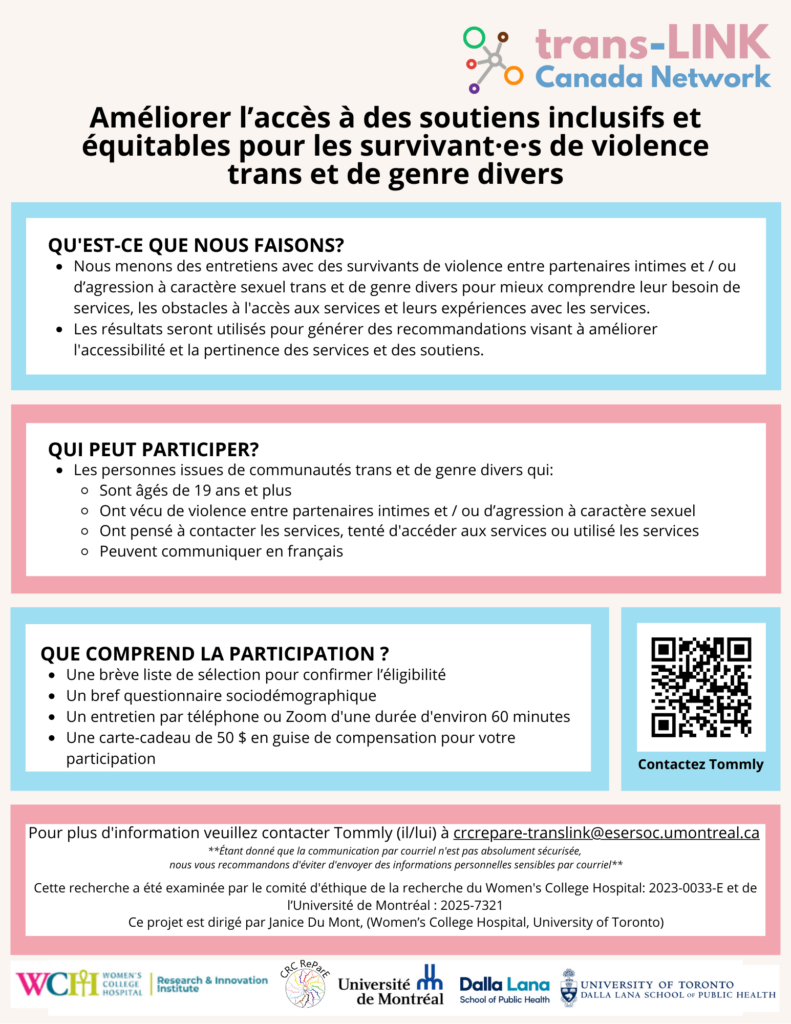
Qu'est-ce que nous faisons ?
Nous menons des entretiens avec des survivant·e·s de violence entre partenaires intimes et / ou d’agression à caractère sexuel trans et de genre divers pour mieux comprendre leur besoin de services, les obstacles à l'accès aux services et leurs expériences avec les services.
Les résultats seront utilisés pour générer des recommandations visant à améliorer l'accessibilité et la pertinence des services et des soutiens.
Qui peut participer ?
Les personnes issues de communautés trans et de genre divers qui:
-Sont âgé·e·s de 19 ans et plus
-Ont un vécu de violence entre partenaires intimes et / ou d’agression à caractère sexuel
-Ont pensé à contacter les services, tenté d'accéder aux services ou utilisé les services
-Peuvent communiquer en français
Que comprend la participation ?
Une brève liste de sélection pour confirmer l’éligibilité
Un bref questionnaire sociodémographique
Un entretien par téléphone ou Zoom d'une durée d'environ 60 minutes
Une carte-cadeau de 50 $ en guise de compensation pour votre participation
Cette recherche a été examinée par le comité d'éthique de la recherche du Women's College Hospital: 2023-0033-E et de l’Université de Montréal : 2025-7321
Ce projet est dirigé par Janice Du Mont, (Women’s College Hospital, University of Toronto)